

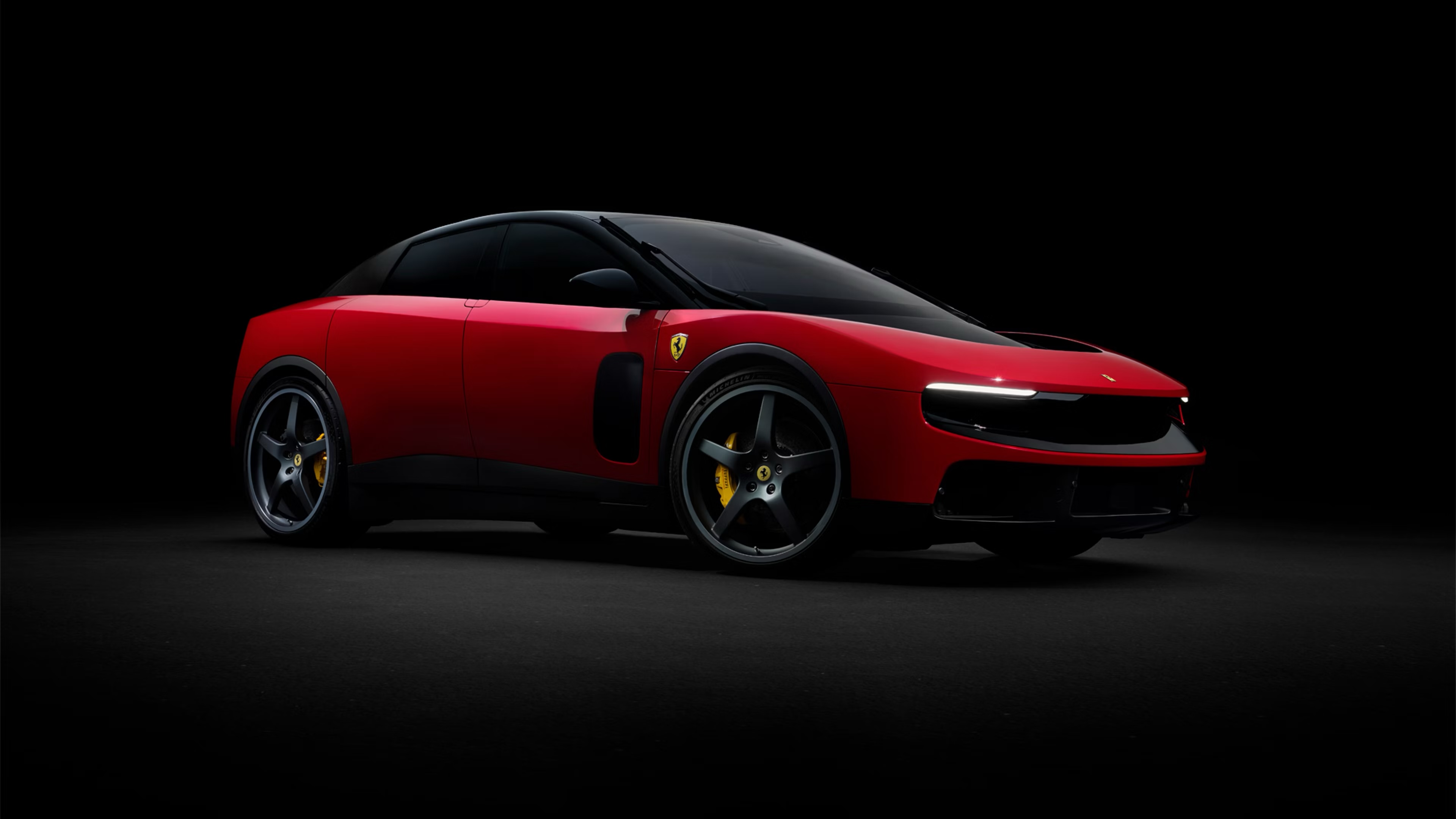
Ferrari’s first fully electric vehicle has arrived — and the reaction from markets, fans, and politicians has been anything but warm. The unveiling of the Ferrari Luce in Rome on 25 May sent the Italian marque’s shares tumbling more than 8% in a single session, making it one of the most consequential product launches in the brand’s modern history.
What is the Ferrari Luce?
The Luce — Italian for “light” — is Ferrari‘s boldest departure from its combustion-engine heritage. It is a four-door, five-seat electric sedan, a body configuration the Maranello brand has never produced before. Priced at €550,000 (approximately $640,000), it is one of the most expensive electric vehicles ever offered for sale.
Under the bodywork sits a formidable powertrain: four permanent magnet synchronous motors, one at each wheel, delivering up to 1,040 horsepower. Ferrari claims a 0–100 km/h time of 2.5 seconds, a range of approximately 530 kilometres, and 350 kW fast-charging capability from a 122 kWh battery pack sourced from SK On. The car also features 48V active suspension — precise enough, Ferrari says, to eliminate the need for conventional anti-roll bars — alongside four-wheel steering and record 23-inch front and 24-inch rear wheel sizes for a production Ferrari.
The design was entrusted to LoveFrom, the creative collective co-founded by former Apple Chief Design Officer Sir Jony Ive and Australian industrial designer Marc Newson. The result is a minimalist, shell-like form with a panoramic glass roof, rear-hinged passenger doors, a floating aerodynamic wing structure at both ends, and an interior built around precision-machined mechanical controls, Gorilla Glass surfaces, and a steering wheel made from 100% recycled aluminium.
According to Newson, the project did not begin as an EV exercise. He told Dezeen: “This didn’t start life as an EV. It was very much a case of setting a bunch of objectives — four doors, five seats — and we decided collectively that using an EV platform would afford us the best opportunity to tick a lot of those boxes.”
Markets respond with an 8% sell-off
The market verdict was swift and unambiguous. Ferrari’s Milan-listed shares closed down 8.4% on the day of the unveiling, while US-listed shares on the New York Stock Exchange fell 5.3%. It was one of the sharpest single-day drops for the stock in recent memory.
Analysts attributed the sell-off to a combination of design scepticism and longer-term strategic concerns. Fabio Caldato, portfolio manager at AcomeA SGR — a Ferrari shareholder — told Reuters the reaction reflected “an aesthetic disappointment, which follows significant concerns over the expansion of its range to include electric models.” He added that the firm remained “rational” and assumed the Luce might appeal only to a niche set of buyers.
Morningstar‘s chief equity strategist Michael Field pointed to a deeper tension: “Ultimately, many fans are disappointed that Ferrari is embracing the EV concept, believing it dilutes the supercar brand, which has modelled itself around classic design and raw, combustion-engine power.” He added that from an investment standpoint, the high research and development costs of EV development were already weighing on investor sentiment before the car was even seen.
RBC Capital Markets flagged concerns that the Luce’s aerodynamics-first design, which prioritises smoothness over the downforce typical of a Ferrari, “could weigh on residual values.” That said, RBC analysts drew a direct parallel to the Purosangue SUV unveiled in 2022, which initially drew investor scepticism before going on to become one of Ferrari’s bestselling models with demand consistently exceeding supply.
Critics, politicians, and the internet pile on
Beyond the financial markets, the cultural response has been equally pointed. Autocar editor-at-large Matt Prior captured the dominant sentiment succinctly, telling Fortune: “The internet has made up its mind. And it’s not universally loved from the outside.” He conceded the interior was well executed, but maintained the Luce did not “shout Ferrari.”
Italy’s Deputy Prime Minister and Transport Minister Matteo Salvini — himself a vocal Ferrari admirer — offered one of the more blunt assessments, quoted by CNBC: “Electric, outrageously expensive, and from an aesthetic point of view, it speaks for itself… It looks like anything but a car from the Prancing Horse. And this is supposed to be ‘innovation’?”
On social media, comparisons to mass-market EVs proliferated. Bloomberg reported that critics and influencers alike compared its four-door silhouette to mainstream electric sedans — an unflattering framing for a brand whose identity is built entirely on exclusivity and performance theatre. One publication noted the design’s resemblance to long-circulated concept renders of Apple’s cancelled Project Titan iCar, a comparison unlikely to sit well with traditionalists in Ferrari’s core fanbase.
Ferrari’s intended audience is not the internet
Ferrari CEO Benedetto Vigna acknowledged the polarised response but remained resolute. He told CNBC on launch day that the Luce represented “a very, very important day” and “a new chapter” in the company’s history.
The Luce is explicitly targeted at a new generation of wealthy buyers, particularly technology entrepreneurs in markets such as Silicon Valley and premium EV buyers in China, where electric vehicles now command a significant and growing share of the luxury segment. Ferrari is banking on the Luce opening doors to customers who have never previously considered the brand — buyers who want performance and Italian provenance but require practicality and zero-emission credentials.
Deliveries are expected to begin in the fourth quarter of 2026, with the US market launch scheduled for the second quarter of 2027. All components are manufactured in-house at Maranello, reinforcing Ferrari’s longstanding insistence on vertical integration as a marker of premium authenticity.
In an unusual but symbolically loaded moment following the Rome launch, Ferrari brought the Luce to the Pope’s summer residence at Castel Gandolfo, where Pope Leo XIV became the first person outside Ferrari to drive the car. The brand gifted the Pontiff Jony Ive’s bespoke steering wheel design.
Is the backlash premature?
Several voices in the analyst community have urged calm. Bernstein‘s lead analyst Stephen Reitman argued in a research note that Ferrari “has not embarked on this blindly” and that there are enough collectors and new buyers — existing and prospective — “to ensure that Luce firmly establishes its position within Ferrari’s range.”
Citi told investors not to be “overly concerned,” noting that the stock briefly recovered over 2% in early Wednesday trading before settling marginally lower. Electrek made perhaps the most pointed counterargument, observing that beneath the design controversy lies “the most advanced performance electric platform in the industry” — a quad-motor architecture derived from the F80 hypercar, with 48V active suspension and four-wheel steering. The publication drew a direct comparison with the Ford Mustang Mach-E, which moved from “blasphemy” to outselling the combustion Mustang within five years of launch.
The risk Ferrari faces is not the Luce itself, but whether the board loses nerve. With Porsche and Lamborghini both scaling back their EV commitments in response to weaker-than-expected demand, Ferrari’s willingness to press forward with a dedicated electric platform sets it apart — for better or worse. The coming quarters will reveal whether the Luce finds its audience among the Silicon Valley founders and Shanghai entrepreneurs Ferrari is courting, or whether the world’s most famous sports car brand has miscalculated the most consequential product bet in its history.


Share your thoughts