

The jobs most impacted by AI in 2026 are customer service agents, data entry clerks, entry-level software developers, bank tellers, paralegals, and basic content creators — roles built on predictable, rule-based tasks that AI can now perform faster and cheaper than humans.
But the story has a new dimension: physical AI, led by China’s humanoid robot push, is beginning to threaten the blue-collar roles that were once considered safe. Mass unemployment has not materialised yet but displacement is real, concentrated, and accelerating.
Has AI Already Started Replacing Jobs?
When OpenAI launched ChatGPT in November 2022, it triggered a wave of anxiety about AI and job security. The fear was not unfounded. PwC’s 2023 Global Workforce Hopes and Fears Survey — which drew responses from 53,912 workers across 46 countries and territories — found that nearly 30% were concerned their jobs might be replaced by AI within three years. By May 2023, outplacement firm Challenger, Gray & Christmas recorded 3,900 US job losses directly attributed to AI in a single month, according to its May 2023 Job Cuts Report — the first time the firm had broken AI out as a standalone layoff cause.
Three years later, the data has hardened significantly. In 2025, Challenger recorded 54,836 US job cuts attributed to AI — a full-year record. By May 2026, that pace had accelerated sharply: AI became the leading reason for job cuts for the third consecutive month, accounting for 40% of all US layoffs announced in May alone. A total of 87,714 AI-attributed cuts were recorded year-to-date — already far surpassing the entire 2025 total, according to Challenger’s May 2026 Job Cuts Report. Separately, Goldman Sachs Research estimated in April 2026 that AI has reduced monthly US payroll growth by roughly 16,000 jobs — the first time a major Wall Street research desk has isolated AI’s net contribution to job losses from broader macroeconomic trends.
Which Jobs Are Being Replaced by AI Right Now?
Displacement is not spread evenly. The roles seeing the most direct impact share a common trait: they are built on repetitive, structured, information-processing tasks where AI can match or exceed human output at a fraction of the cost.
Customer service and call centre agents
Klarna, the buy-now-pay-later giant, deployed an AI assistant in 2024 that handles the workload equivalent of 700 full-time employees. The company’s headcount fell from roughly 7,000 in 2022 to around 3,000 today, with CEO Sebastian Siemiatkowski publicly targeting below 2,000 by 2030. Salesforce CEO Marc Benioff stated the company reduced its customer support headcount from 9,000 to 5,000 through agentic AI deployment. The US Bureau of Labour Statistics projects customer service representative employment to decline 5% through to 2033.
Entry-level software developers
Microsoft CEO Satya Nadella confirmed that 30% of company code is now written by AI, and over 40% of Microsoft’s May 2025 layoffs targeted software engineers. Tools including GitHub Copilot, Cursor, and Claude Code can generate functional code from natural language prompts — compressing the value of junior developers who primarily produce high-volume, low-complexity code. According to the Stanford HAI AI Index 2026, employment among software developers aged 22–25 has fallen nearly 20% since 2024.
Data entry and administrative processing
Manual data entry faces an estimated 95% automation risk, according to Brookings Institution analysis. AI systems can now scan, classify, and process thousands of documents per hour with fewer errors than human workers. JPMorgan CEO Jamie Dimon confirmed in 2025 that the bank had already automated 20% of its back-office positions. An estimated 7.5 million data entry and administrative roles could disappear globally by 2027.
Translation and language work
Duolingo terminated contracts with 10% of its contractor workforce in January 2024, acknowledging that AI could handle translation tasks across its 100-plus language offerings — one of the clearest documented cases of AI directly substituting human language work at scale.
Medical transcription and coding
Medical transcription is already 99% automated. An estimated 40% of medical coding is projected to be automated in the near term, according to industry data compiled by DemandSage.
Bank tellers and cashiers
The US Bureau of Labour Statistics projects bank teller employment to decline 15% between 2023 and 2033, eliminating around 51,400 positions. Cashier roles are expected to fall 11% over the same period — a reduction of 353,100 jobs — driven by digital banking, mobile payments, and AI-powered self-checkout.
Paralegals and legal researchers
AI tools capable of document review, case research, and contract drafting have put paralegals at an estimated 80% automation risk by 2026, and legal researchers at a 65% risk by 2027, according to industry research compiled by DemandSage.
Are Companies Using AI as an Excuse for Layoffs?
The documented displacement figures come with an important caveat. Some of the most prominent voices in AI have pushed back hard on the narrative — not to deny that displacement is happening, but to call out how it is being exaggerated and misattributed.
Nvidia CEO Jensen Huang, speaking to Channel NewsAsia on 25 May 2026, called the narrative connecting AI to layoffs “lazy” and said it “doesn’t make any sense.” His challenge was a timing one: “AI has just arrived. How is it possible they’re already losing jobs? How is it possible that AI became productive and useful only six months ago, and they were somehow laying people off two years ago because of AI?” Huang said some executives cite AI “to sound smart,” and described scaring workers about AI as “irresponsible.”
Google DeepMind CEO Demis Hassabis made the same argument days earlier, telling WIRED that companies attributing layoffs to AI demonstrate a “lack of imagination.” His position: when AI makes workers more efficient, the rational response is to reinvest those gains into new products and markets — not trim payroll and call it innovation.
The data supports their scepticism in part. An analysis cited by Fortune found that 80% of companies that cut jobs citing AI saw zero improvement in returns. Klarna itself — widely cited as a poster child for AI-driven downsizing — reportedly laid off hundreds of workers for AI reasons, then quietly began rehiring. Challenger’s own chief executive noted in the May 2026 report: “AI isn’t yet the jobpocalypse some predicted… the technology will ultimately make workers more productive, but our data shows companies are already acting on it.”
Will Robots Replace Blue-Collar Workers?
For most of the post-ChatGPT period, the conventional wisdom held that blue-collar and physical jobs were relatively safe from AI displacement. Physical AI — robots capable of operating in real, unstructured environments — is now beginning to challenge that assumption. The leading force is China.
In 2025, China accounted for over 80% of global humanoid robot installations and over half of the world’s industrial robots, according to Barclays research. It has lifted robot density by 600% since 2016, to nearly 500 robots per 10,000 workers. Beijing has made embodied AI a national priority in its 15th Five-Year Plan (2026–2030), with a dedicated “Robot+” initiative and “AI + Manufacturing” roadmap targeting doubled manufacturing robot density by 2030.
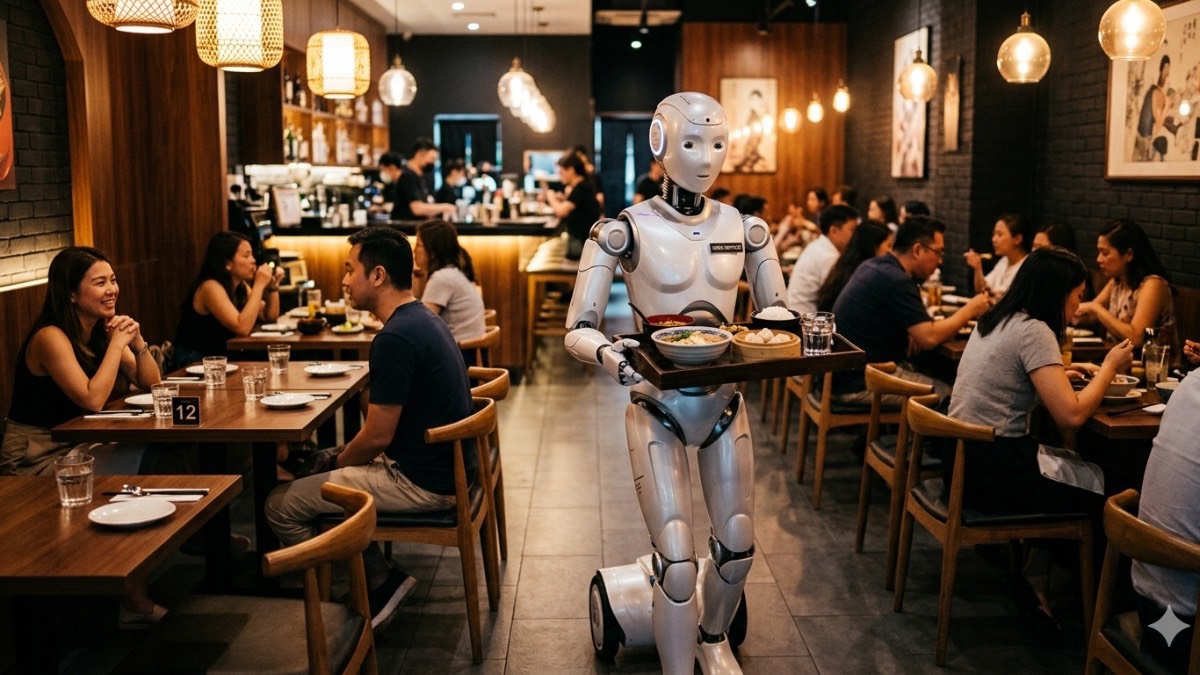
The restaurant industry illustrates how far this has already progressed. Hangzhou opened China’s first fully automated AI robot restaurant in early 2026, with robots stir-frying, boiling noodles, brewing coffee, making ice cream, delivering dishes, and cleaning floors — no human cooks. McDonald’s trialled humanoid robots in a Shanghai outlet for food delivery and customer interaction — targeting roles traditionally considered too unpredictable to automate. At Mobile World Congress 2026, China Mobile demonstrated a robot-only restaurant achieving 92% order accuracy across the full workflow.
The accuracy gap that human waiters introduce — delivering food to the wrong table — is being closed by RFID-based table tracking systems, where passive tags mounted beneath each table link orders to precise locations the moment a customer sits down, transmitting directly to kitchen display systems in real time. DoorDash’s SmartScale device extends this into the kitchen, using weight-sensing and predictive modelling to verify every order before it leaves the counter, reducing missing item claims by up to 30%.
Barclays forecasts two waves of humanoid deployment: the first, running through 2030, targets manufacturing, logistics, agriculture, and construction; the second, post-2030, moves into healthcare, elderly care, education, and hospitality. As of mid-2026, humanoid robots can reliably walk on flat surfaces, navigate obstacles, pick up and place objects, follow verbal commands, and perform repetitive manufacturing tasks. Key limitations remain: highly dexterous tasks, cluttered unpredictable environments, and battery life of 2–4 hours per charge.
Which Jobs Are Most at Risk From AI — and Which Are Safe?
- Highest risk (displacement already underway): data entry clerks, customer service agents, medical transcriptionists, bank tellers, cashiers, basic content writers, translation workers, entry-level software developers
- High risk (displacement accelerating): paralegals, financial analysts, back-office banking roles, administrative assistants, graphic designers producing high-volume routine work, call centre agents
- Moderate risk (task automation, roles evolving): accountants, sales representatives, mid-level coders, marketing analysts, procurement specialists
- Lower risk (physical presence, human judgment, care): electricians, plumbers, HVAC technicians, construction workers, nurses, therapists, teachers, personal care workers, chefs at the high end of the craft
The pattern is consistent across all major research: roles built on predictable, codifiable, information-processing tasks face the highest risk — regardless of whether they sit in a white-collar office or on a production floor.
Roles requiring physical judgment in variable environments, licensed professional decision-making, or complex human emotional interaction face the lowest near-term displacement risk.
Will AI Create More Jobs Than It Destroys?
Despite the documented displacement, every major institution projecting through to 2030 arrives at net job creation. The World Economic Forum’s Future of Jobs Report 2025 projects 170 million new roles created and 92 million displaced by 2030 — a net gain of 78 million jobs. AI specifically is forecast to create 11 million jobs and displace 9 million, a net positive of 2 million.
The problem is not the net figure — it is the transition. Goldman Sachs research published in April 2026 found that technology-displaced workers’ real earnings remained 10 percentage points below those of non-displaced workers even ten years after job loss, with slower wealth accumulation, delayed homeownership, and delayed household formation — effects amplified during recessions.
Jensen Huang’s advice to workers navigating this shift remains the most cited: “You’re not losing your job to AI, but to someone who uses AI better.” The WEF found that 77% of employers aim to upskill staff for working with AI — and 39% of existing skill sets are expected to become outdated between 2025 and 2030. The window to adapt is open. It is not indefinitely wide.


Share your thoughts