

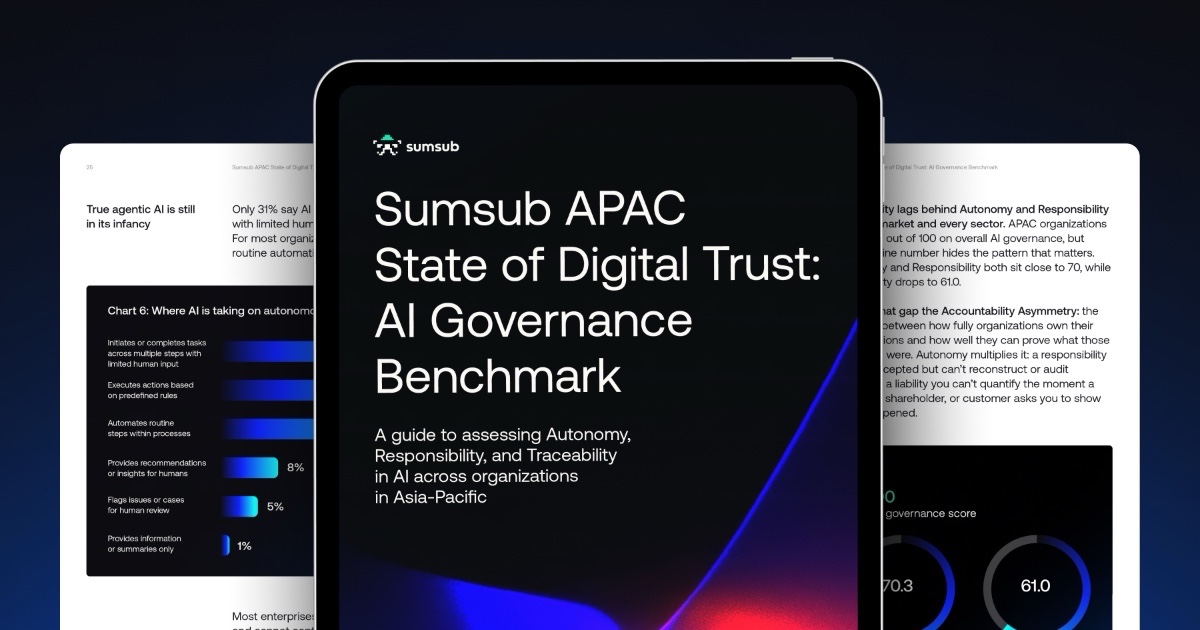
Nearly all Singapore businesses have embraced agentic AI, but few can prove how their AI systems arrive at decisions, according to new research from Sumsub and the Singapore FinTech Association (SFA).
The APAC State of Digital Trust: AI Governance Benchmark report found that while 94 per cent of Singapore businesses are now using or piloting multi-step AI systems, only 29 per cent can produce an audit trail to prove their AI-driven decisions. Sumsub and the SFA describe this shortfall as an “Accountability Asymmetry” — a widening gap between how much organisations rely on AI and how well they can actually account for its choices to regulators, shareholders or customers.
Singapore’s AI governance gap by the numbers
The study, conducted with Blackbox Research between April and June 2026, surveyed 720 senior professionals across nine APAC markets, evaluating each on three dimensions: how far AI is already acting independently, how clearly ownership of AI-driven outcomes is defined, and how well those decisions can be reconstructed and explained.
- 70 per cent of Singapore businesses maintain explicit guidelines assigning direct responsibility for AI outcomes to a specific person or team, in line with the APAC average.
- 90 per cent express comfort letting AI handle low-risk routine tasks, but caution rises sharply once financial liabilities are involved.
- Only 16 per cent significantly increased the scope or autonomy of their AI systems in the past year — the most measured deployment rate in APAC.
- 98 per cent say they are ready to adopt a third-party verification solution that ties autonomous AI actions back to a verified identity network.
Singapore scored 65.6 on the overall governance benchmark, just below the APAC average of 67.1 and behind Thailand (70.3) and the Philippines (69.6). Sumsub and the SFA attribute this not to weak governance, but to Singapore’s more rigorous self-assessment standard, set by the Infocomm Media Development Authority’s Model AI Governance Framework for Agentic AI — the first such framework issued by any government.
“Everyone is focused on how quickly AI is advancing, but the bigger question is whether governance is keeping pace. Our joint survey with Sumsub found that fewer than one in three organisations can produce an audit trail for AI-driven decisions,” said Holly Fang, President, Singapore Fintech Association.
Financial services and IT lead, e-commerce lags
Regulated sectors dominate the benchmark. Financial services topped the index at 69.6 points, helped by a region-leading 68 per cent audit trail adoption rate, followed closely by IT and software services at 68.8. E-commerce (65.4) and mobility and delivery (64.4) trailed, favouring speed of deployment over independent audits.
Singapore businesses cited three engineering priorities to scale AI safely: navigating the technical complexity of modern models (66 per cent), platform integration (50 per cent), and building tracking parameters for third-party AI tools (49 per cent).
“Prudence, rather than a lack of strategic intent, defines how the enterprises are scaling AI agents,” said Penny Chai, Vice President, APAC at Sumsub. “When financial liabilities are on the line, immature traceability systems create an unacceptable operational risk.”
Chai added that the next phase depends on the tech sector building the “operational plumbing” to match regulatory frameworks such as the Monetary Authority of Singapore’s Safeguards for Agentic Finance at Runtime (SAFR), anchoring automated actions to a secure, human-accountable digital trail.


Share your thoughts