

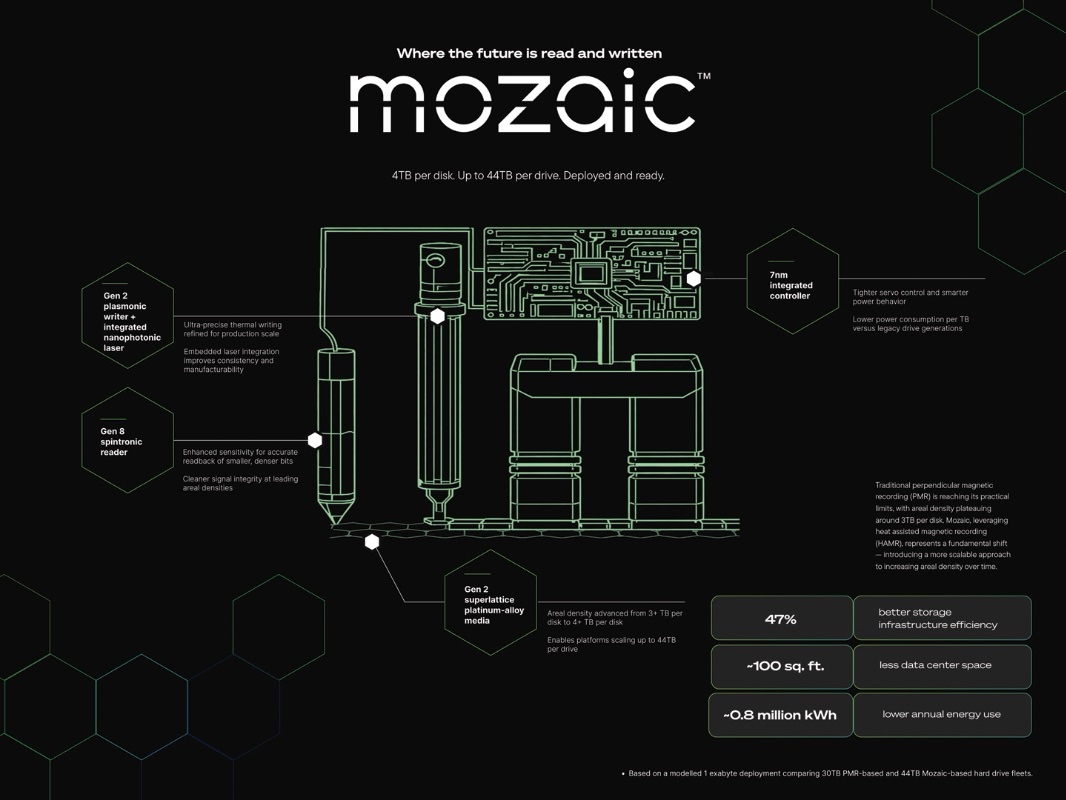
Seagate Technology has begun production deployments of its Mozaic 4+ storage platform, a heat-assisted magnetic recording (HAMR) technology designed to increase hard drive capacity for hyperscale cloud infrastructure.
The platform has been qualified by two hyperscale cloud providers and supports hard drives with capacities of up to 44TB, marking one of the first large-scale deployments of HAMR technology in data centres.
The launch comes as artificial intelligence systems and cloud services drive rapid growth in data creation and long-term storage demand.
“Data has become one of the most valuable assets for enterprises, fuelling business insights, enhancing productivity, and enabling competitive advantage,” said Dave Mosley, chief executive officer of Seagate. “Seagate’s HAMR-based Mozaic products deliver the scale, performance and efficiency customers need to unlock the full potential of their data.”
HAMR technology targets higher storage density
The Mozaic 4+ platform uses heat-assisted magnetic recording, which employs a tiny laser to briefly heat disk material during writing. This enables data to be stored at significantly higher densities than traditional magnetic recording.
The system integrates a new suspension architecture and an upgraded system-on-a-chip designed to support more precise data recording while maintaining enterprise-grade reliability.
A key component is Seagate’s in-house laser technology used in HAMR recording. Developed through years of nanophotonics engineering, the vertically integrated design allows tighter control over manufacturing yield, reliability and supply chain resilience.
The platform forms part of a longer-term roadmap to increase per-disk capacity from roughly 4TB today to about 10TB, potentially enabling hard drives approaching 100TB in the future.
AI workloads driving storage demand
Expanding artificial intelligence workloads are placing new pressure on cloud infrastructure. Large AI models require extensive datasets for training and fine-tuning, while AI-generated content — including video and multimodal outputs — continues to increase storage needs.
Mass-capacity hard drives remain a cost-efficient solution for hyperscale operators seeking to store and manage large volumes of data.
According to Seagate’s internal estimates, a one-exabyte deployment using Mozaic technology could improve infrastructure efficiency by about 47 per cent compared with standard 30TB drives. Such deployments could also reduce data centre footprint by around 100 square feet and lower annual energy consumption by roughly 0.8 million kilowatt-hours.
Bob O’Donnell, president of TECHnalysis Research, said advances in storage density are becoming increasingly important for AI infrastructure.
“As AI models have evolved and GenAI-powered applications have expanded their capabilities and reach, it’s become abundantly clear that the need for massive amounts of data — both real and synthetically generated — is essential to keep AI advancements moving ahead,” he said.
Availability
Drives based on the Mozaic 4+ platform are already shipping in volume to two hyperscale cloud providers, with additional customer qualifications underway.
Broader availability is expected as production ramps up and cloud operators expand infrastructure to support AI-driven data growth.


Share your thoughts