

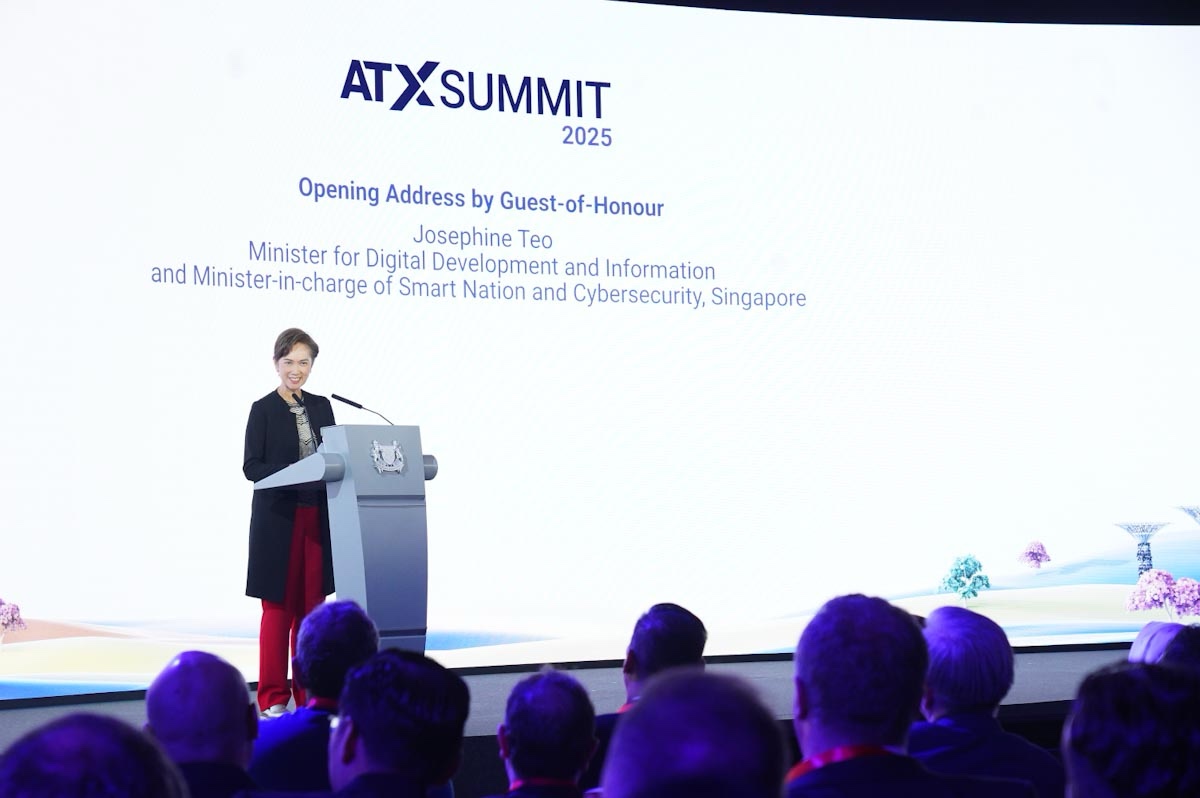
Singapore has unveiled a sweeping series of artificial intelligence (AI) initiatives, cementing its ambitions to become Southeast Asia’s AI powerhouse. Speaking at the ATxSummit 2025, Minister for Digital Development and Information, Mrs Josephine Teo, announced major upgrades to the country’s homegrown large language model (LLM), MERaLiON, the launch of a new AI consortium, and fresh global partnerships aimed at operationalising AI safety and digital trust frameworks.
Originally launched in December 2024, MERaLiON – short for Multimodal Empathetic Reasoning and Learning in One Network – has been significantly enhanced to support a broader range of Southeast Asian languages, including Malay, Tamil, Thai, Bahasa Indonesia, and Vietnamese, alongside its existing support for English, Mandarin and Singlish. These upgrades also enable more sophisticated emotional recognition and code-switching, making the model more adaptable for use in culturally nuanced sectors such as customer service, healthcare and social services.
“MERaLiON’s emotional intelligence and multilingual capability are game-changers for AI adoption in diverse markets across Southeast Asia,” said Mrs Teo. The model has already clocked over 90,000 downloads globally since its debut.
To accelerate real-world deployment, Singapore launched the MERaLiON Consortium – a collaborative effort bringing together local agencies and major tech players such as Grab, DBS Bank, Microsoft Singapore and SPH Media. Research institutions like HTX, MOH’s Office for Healthcare Transformation, and the National Supercomputing Centre will work alongside industry to develop agentic AI systems, multilingual support tools and healthcare solutions.
AI Safety at the Forefront

Photo credit: IMDA
Alongside technological advancement, Singapore is also carving out a leadership role in AI safety and governance. The country’s hosting of the 2025 Singapore Conference on AI yielded the Singapore Consensus on Global AI Safety Research Priorities—l – a foundational document set to guide the ATxSG Ministerial Roundtable on Digital Trust. The aim: bridge AI science and policymaking through structured, evidence-based dialogue.
In line with these ambitions, Singapore has expanded its AI Verify Testing Framework to include risks associated with generative AI. This was developed in tandem with the US National Institute of Standards and Technology (NIST), aligning the framework with the NIST AI Risk Management Framework. The move signals deepening bilateral cooperation on AI governance.
Deepening International Partnerships
Singapore also inked a Joint Statement on AI Safety with France’s AI Safety Institute, reinforcing international collaboration in this high-stakes area. The agreement was signed by Mrs Teo and French Minister Delegate for AI and Digital Technologies, Mrs Clara Chappaz, at the ATxSG summit.
Additionally, Singapore and the United States are spearheading the rollout of the Global Cross-Border Privacy Rules (CBPR) Certification, allowing companies to demonstrate adherence to globally recognised data protection standards. The certification will be open to applicants from 2 June 2025, granting access to markets valued at approximately US$40 trillion. Companies such as OCBC, IBM and Mastercard are expected to transition to the global scheme from the current APEC CBPR programme.
Healthcare and Scam Prevention Also in Focus

Photo credit: IMDA
On the healthcare front, homegrown firm Enigma Health – a spin-off from the SingHealth Duke-NUS Academic Medical Centre – announced partnerships with Roche and ST Engineering to scale its AI platform, which streamlines clinical workflows and strengthens data governance in medical environments. The Enigma platform, already piloted within SingHealth, will soon be rolled out more widely.
And in a regional step to bolster cybersecurity, the Infocomm Media Development Authority (IMDA) signed a Memorandum of Understanding (MoU) with Thailand’s National Broadcasting and Telecommunications Commission (NBTC) to tackle cross-border telecom scams. The agreement covers shared intelligence, call traffic analysis, and stronger regional security protocols.


Share your thoughts