

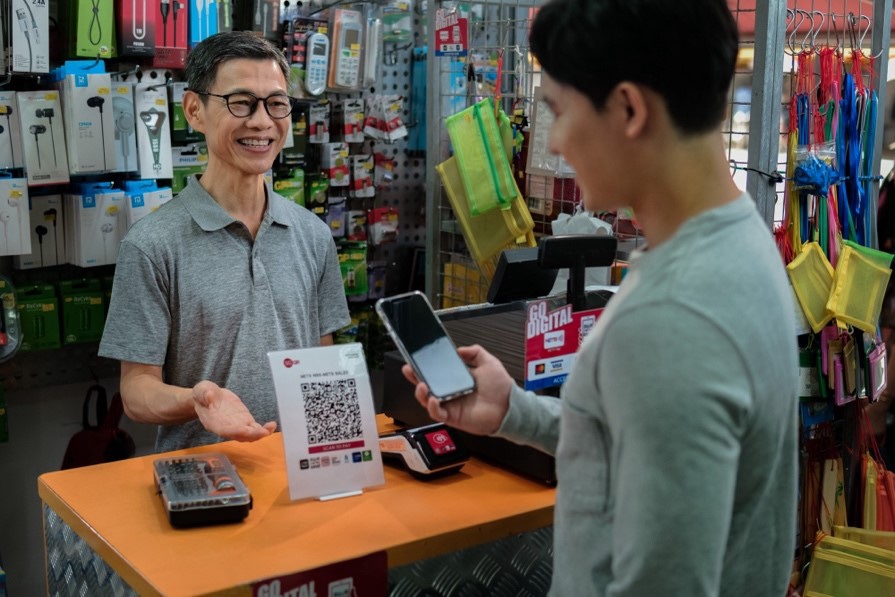
Network for Electronic Transfers (NETS) announced an ambitious expansion of the Singapore Quick Response Code Scheme (SGQR+) to 35,000 acceptance points, with a focus on interoperability across the island’s payment networks. This expansion follows a successful proof of concept (POC) last November and includes plans to bring the unified QR code payment option to hawker stalls and small businesses.
The upcoming commercial rollout aims to simplify the payment process for both merchants and customers by allowing multiple payment schemes through a single SGQR label. Customers at 16,500 participating merchants, including popular local brands like Arnold’s Fried Chicken and Twelve Cupcakes, will soon be able to scan the SGQR+ label to pay via their banking apps or digital wallets.
Mr. Lawrence Chan, Group CEO of NETS, emphasized the program’s potential to reduce operational complexity for merchants. “With NETS, each merchant only needs one commercial arrangement to accept payments from multiple domestic and inbound payment options,” Chan said.
Integration Across New Partners and Enhanced Efficiency
The nationwide rollout will bring on three new issuers: dtcpay, MariBank, and Maybank, each expected to be fully operational by mid-2025. The integration of these new partners is designed to bolster the SGQR+ network, potentially expanding its reach by 10% annually.
Miguel Pereira Tanco, Director of ZooMoov, praised SGQR+ for streamlining operations and broadening customer payment options. The initiative has reportedly increased efficiency and reduced administrative overhead for participating businesses.
Regional Ambitions and Interoperability Gains
SGQR+ builds on the foundation set by the Monetary Authority of Singapore’s (MAS) initial SGQR initiative in 2018, which aimed to unify disparate QR payment systems under one framework. With cross-border payment capabilities already active for China, Indonesia, Malaysia, and Thailand, SGQR+ now has the potential to extend interoperability regionally, a move that could further enhance the consumer payment experience and broaden the platform’s appeal.
During last year’s POC, merchants in the Changi district saw significant growth in transaction volumes and an increase in accepted payment schemes, rising from three to an average of twelve schemes per merchant. The promising results signal a strong demand for QR payment consolidation, paving the way for an even more integrated digital payment landscape across Singapore.


Share your thoughts