

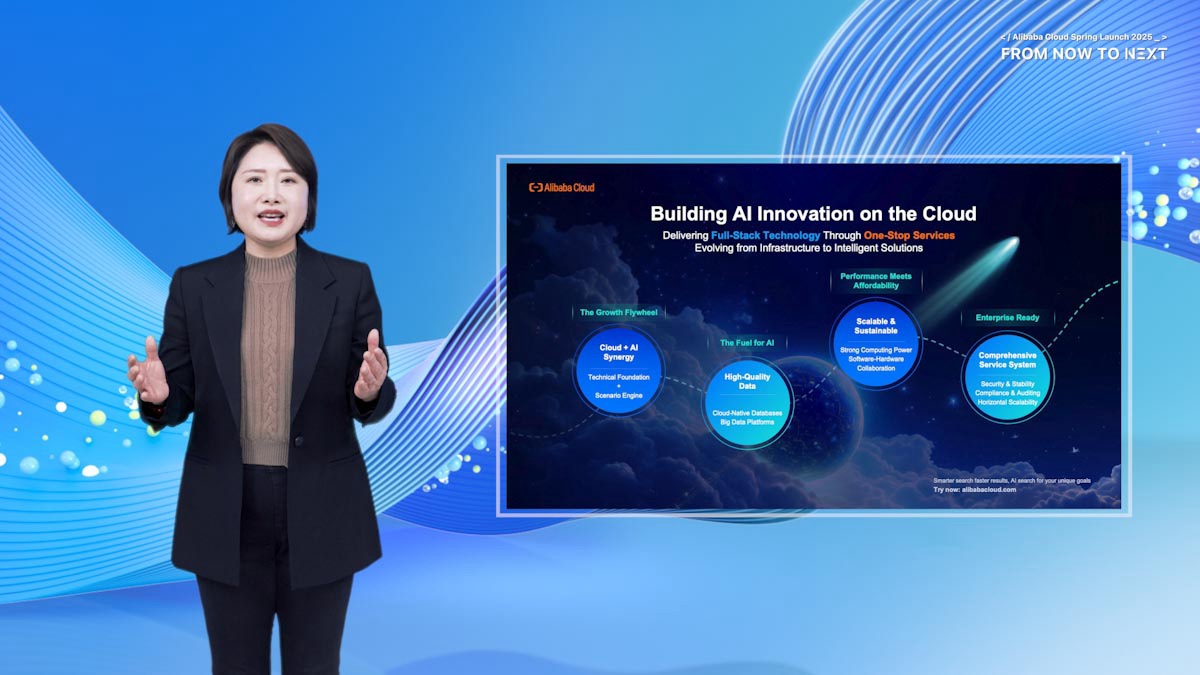
Alibaba Cloud has launched a sweeping upgrade of its AI capabilities, unveiling new models, enhanced platforms and smarter SaaS tools at its Spring Launch 2025, reinforcing its ambition to become a leading player in the global AI and cloud computing race.
The upgrades are underpinned by a significant infrastructure investment, part of the US$53 billion Alibaba committed earlier this year to advance its cloud and AI capabilities over the next three years – surpassing its total spend in the past decade.
Selina Yuan, President of International Business at Alibaba Cloud Intelligence, said the new updates are designed to help businesses “scale and innovate in an AI-driven world.”
“As cloud and AI become essential for global growth, we are committed to enhancing our core product offerings to address our customers’ evolving needs,” Yuan said.
Smarter AI Models in Singapore
A highlight of the announcements was the international rollout of Alibaba Cloud’s latest proprietary models under its Qwen series. These include:
Qwen-Max, a large-scale Mixture of Experts model, QwQ-Plus, designed for deep analytical reasoning and complex problem solving, QVQ-Max, a visual reasoning model supporting multimodal inputs, Qwen2.5-Omni-7b, a compact end-to-end multimodal model.
All are now available through Alibaba Cloud’s availability zones in Singapore.
Infrastructure Designed for Scale
To accommodate the increasing scale and complexity of modern AI applications, Alibaba Cloud’s Platform for AI (PAI) has rolled out significant performance upgrades. The PAI-Elastic Algorithm Service (EAS) now supports distributed inference via multi-node architecture—an essential capability for running super-large MoE models and processing ultra-long texts.
One of its standout enhancements is a new prefill-decode disaggregation feature that has dramatically improved model throughput. When applied to the Qwen2.5-72B model, it boosted concurrency by 92% and token processing by 91%, significantly improving scalability and efficiency.
The PAI-Model Gallery now features nearly 300 open-source models, including the full Qwen and Wan series, and offers no-code deployment and advanced model management tools, such as performance evaluation and model distillation to lower deployment costs.
AI Inside the Database
Alibaba Cloud has also infused its AI capabilities directly into its core database services. Its flagship relational database PolarDB now includes native inference powered by Qwen, enabling in-database machine learning and reducing latency by eliminating the need to move data for processing.
This is complemented by tighter integration of AnalyticDB with Model Studio – Alibaba Cloud’s development platform for generative AI—making it the recommended vector database for Retrieval-Augmented Generation (RAG) use cases. This allows developers to more easily build context-aware AI applications by connecting their proprietary knowledge bases directly to deployed models.
New SaaS Tools for Industry Transformation
To help industries accelerate digital transformation, Alibaba Cloud introduced two new AI-powered SaaS offerings:
AI Doc, a document processing tool that uses LLMs to extract information from business documents and generate customised reports, including those for ESG reporting. Smart Studio, a creative content platform that supports text-to-image, image-to-image, and text-to-video generation, aimed at e-commerce, gaming, education and entertainment sectors.
These tools aim to make enterprise-level AI more accessible and user-friendly across industries.
AI-Powered Search and Partner Incentives
The company also launched a Qwen-powered AI search assistant on its website to help SMEs discover solutions and access training resources faster. This initiative complements a newly revamped partner programme that offers more attractive incentives and training to resellers and distributors worldwide.


Share your thoughts